Showing posts with label Syrian Civil War. Show all posts

Saturday, 27 September 2014

Here We Go Again

  MPs in the House of Commons yesterday voted by 524 to 43 in favour of UK airstrikes against IS targets in Iraq. Ladies and gentlemen, here we go again. Barack Obama last week became the fourth successive US President to declare on live television an American bombing campaign in the Iraq region; now, David Cameron joins him in declaring military action in the failing state just three years after the last British forces withdrew from the country.

  War in Iraq seems to have become something of a hobby for the Anglo-American military-industrial complex. This time, though, we are not fighting the iron-fisted tyrant that was Saddam Hussein - instead, the enemy is a group of ultra-radical fundamentalist Islamists; a group whose interpretation of the Qur'an combins the worst evils of the early campaigns of bloodshed emanating from seventh-century Medina and more modern Wa'habist ideologies of an ultra-strict religious conservatism and adherence to a twisted brand of Sharia law. A target, therefore, one might think worthy of Britain's aggression? Perhaps.

  The problem is, though, so much of the current problem is derived directly from the Iraq War of 2003 and the earlier Gulf War of 1990. Despite the protestations of senior government figures to the contrary, blowback from overseas theatres of war is a real and present problem, and the history of modern British and American involvement in the Middle East is scarred with it. From the Afghan campaigns of the 1980s, which kickstarted the rise of the Taliban, to the brutal murder of Drummer Lee Rigby last May - whose perpetrators explicitly stated their aim as revenge for slaughtered Muslims in Iraq - the US-UK alliance is dogged by bloody reprisals against their people for the governments' actions abroad.
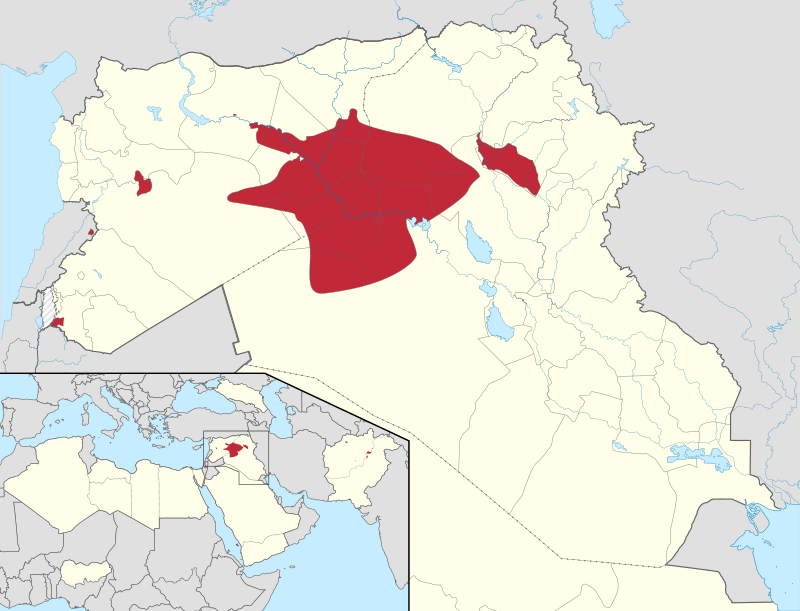
The territory controlled by the IS as of 22/09/14
  The success of the Islamic State, formerly an al-Qaeda offshoot, is based to a not inconsiderable degree on the violent actions of Western powers in the Middle East over the last half-century or so. The Arab Spring may have destabilised the region enough for ISIS to emerge in Syria, but it has been the justified hatred of Western interventionism which has helped to fuel its transformation from one of many small rebel groups set against the Assad regime to a de facto independent country straddling the borders of two of the regions former powers, and it is the weakness and sectarianism of Iraq in the wake of the Alliance's disastrous earlier invasion which has allowed the armies of Islamist extremism to run roughshod across the lands once home to the greatest civilisations on Earth.

  So, here we go, back into Iraq. So far the UK - along with the other European powers participating in the action (Denmark and Belgium) - are loathe to expand operations into Syria, but now that the USA has taken that step, in defiance of Assad's protestations of illegality, it can only be a matter of time. This war will be one without borders, one which Cameron has said could take three years but which could easily last five times that. Another war in an unstable area, and what will we be left with at the end of it? Two shattered states, a Middle East infected with a stronger poison of religious extremism than ever before and greater and greater hatred for the 'Great Satan' of Western intervention.

  And that's assuming we even win.

Wednesday, 2 July 2014

ISIS and the War for the Middle East

  The situation in Iraq is dire, and growing more so almost by the hour. The incursion of Salafi Jihadists fighting under the banner of ISIS into the north-west of the country represents an existential threat to the country's fragile democracy. Around 7,000 fighters have put an army of over a quarter of a million to rout and seized control of around a third of Iraqi territory. This is a staggering feat for an organisation which did not exist fifteen years ago.


  Things are worse, though, than they appear at first glance, because this war is neither explainable in terms of bipolar conflict nor limited to Iraq. The map to the right shows the current state of Iraq and Syria, with the territories controlled by the major players detailed. The green areas in the north are under the control of the Iraqi and Syrian Kurds, the pink area to the west is held by Assad's regime in Damascus and the purple area is under Iraqi Prime Minister Nouri al-Maliki's control. The light blue areas are held by the Free Syrian Army and other, largely moderate Syrian rebel groups. The grey area is ISIS. 

  It is immediately obvious that a warzone of this size and complexity is about far more than just ISIS vs. Baghdad. This war is one which has origins dating back decades, even centuries, and which has the capacity to spill over yet more borders and engulf more of the Middle East. To understand the nature of this war, it is first necessary to look at the fundamental roots of the conflict in the region. Oldest and perhaps most pressing of these is the schism between Sunni and Shia Islam.


Death of a Prophet

  It was the death of the Prophet Muhammed in the year 632 AD (10 AH according to the  Islamic Hijri calendar) which catalysed the great schism. With the Prophet who had united the Arabs and began the conquest of the Middle East dead, a new leader for the fledgling Rashidun Caliphate had to be chosen. The eventual choice, Muhammed's father-in-law Abu Bakr, was made by general consensus, as was the Arabian custom of the time, a method which is supported by the Sunni community. The Shia, however, believe that only Allah may choose a leader, and that - through Muhammed - he had selected Ali (Muhammed's son-in-law) as the Prophet's successor.

  Although Ali did eventually become Caliph, after the assassination of 3rd Caliph Uthman ibn Affan in 656 AD, the split between these two Islamic factions remained. The massacre after the Battle of Karbala in 61 AH (680 AD) intensified and solidified the divide. Though this is, to all intents and purposes. ancient history, the importance of these events for Sunni and Shia alike remains very real. Over time, different cultural and religious practices have further differentiated the two groups and the rivalry between them has grown.

  It is the political divide which most concerns the current situation. The Islamic world has seen significant violence between Sunni and Shia Muslims over the centuries, and this has intensified in recent years. From Pakistan to Yemen, inter-sect conflict has become the norm for the divided Muslim community. In the majority of Muslim countries, Sunnis are the larger group, and Shias are often persecuted.  Iraq itself has been one of the worst-hit places; in the aftermath of the 2003 Iraq War the incidence of Sunni-Shia killings has frown dramatically. By 2008, over 1100 Sunni suicide bombers had attacked Shia-populated areas, whilst government-sponsored Shia death squads routinely tortured and killed Sunnis in the early years of the new Iraqi state. 

  Nouri al-Maliki has proven himself a sectarian leader of the worst kind. His government has discriminated against and disenfranchised Iraq's majority Sunni Arab population and the Kurds in the north in favour of the Shia Arab community to which he himself belongs. His first reaction to the incursion of ISIS forces into his country was not to remedy the relative lack of Sunni officials in his government in the interests of national unity, but to remove those few who did exist and arrest his own (Sunni) Deputy Prime Minister. This is a man chosen by the electorate of Iraq to lead their country through this crisis, but to whom a large portion of the blame can be ascribed and whose current policies are only making a bad situation worse. 

  His warning to the USA that, should they not initiate bombings against ISIS, he will ask the Iranians to instead belies this sectarian agenda. The Iran-Iraq War of the 1980s may have been initiated by Saddam Hussein's megalomania, but the conflict - the twentieth century's longest - has left scars in the minds of many in Iraq, and the country is widely disliked by the Sunni population due to its Shia theocracy. With the dubiously reformist Rouhani as Maliki's main regional ally, and the Sunni Saudis allegedly funding ISIS, this latest outbreak of bloodshed can be firmly set against the larger background of inter-denominational friction going back over thirteen centuries. 


The Poison of Empire

  As well as the Sunni-Shia conflict, the current war also draws heavily upon the legacy of Europen imperialism in the last two centuries, and Anglo-American neoconservative foreign policy in more recent years. ISIS have released a video proclaiming the establishment of their new Caliphate the 'end of Sykes-Picot'. This refers to the secret Sykes-Picot agreement of 1916, which divided the then-Ottoman-ruled lands of Greater Syria and the Levant into British and French spheres of influence. Exposed by the Bolsheviks after they seized control of Russia in 1917, the Agreement broke promises made by the Triple Entente to the Arabs of a single, independent nation-state for their home. It also implicitly committed the Allied powers to Zionism - hardly a recipe for a good start to Arab-European relations.

  Sykes-Picot drew arbitrary borders across the map of the soon-to-be-defeated Ottoman Empire which made no effort to correspond to the actual distribution of ethnic and religious groups in the region. It is mainly down to the peculiarities of this clandestine treaty that the Kurdish people are divided between Iraq, Iran, Syria and Turkey rather than having their own home; that the Sunni Arabs of Western Iraq and Eastern Syria share states with their Shia and Alawite counterparts rather than each other; and, ultimately, why ISIS has been able to overrun large swathes of both countries by exploiting existing divisions within their fragile structures.

  If Sykes-Picot created the unstable base upon which the whole collapsing edifice of Middle Eastern relations is built, then it was the wars waged by the US-led coalitions in 1991 and 2003 which set the walls tumbling. Whilst the Gulf War was arguably justifiable - Hussein's government had launched an unprovoked attack on a small, oil-rich neighbour - it certainly had consequences which go far beyond the cost of lives and capital expended in waging it. It was this war, after all, which spawned al-Qaeda. The Iraq War, though, was entirely unjustifiable: It was launched without UN backing, sold to the British and American people on false pretenses and fought in the most incompetent manner possible, with virtually no thought given to what would become of the country in its aftermath. 

  The Iraq War shattered the country, and sparked waves of unrest which have engulfed the entire region. Tony Blair may bluster that his pet invasion has nothing to do with ISIS, but anyone with a modicum of common sense - let alone any knowledge of the area and its history - should be able to see through this transparent facade. ISIS is certainly not solely the responsibility of the Blair-Bush alliance, but those two megalomaniacs cannot and should not escape their fair share of the blame.


The Evolution of ISIS

  Despite the recent eruption in media coverage, ISIS itself did not suddenly explode out of nowhere. It began life in around 2000 as Jama'at al-Tawhid wal-Jihad (JTJ), the project of Jordanian Salafi Abu Musab al-Zarqawi. Zarqawi - a veteran, like Osama bin Laden, of the Afghan Mujaheddin - originally intended the group to overthrow the Jordanian government, but the group moved to Iraq in 2001 following the Anglo-American invasion of Afghanistan. Foreign Islamic fighters travelling to Iraq to fight against the Western invasion forces from 2003 onwards became increasingly dependent on JTJ and the group's main objectives became the ejection of the occupation forces, the elimination of the Iraqi Shia community and the establishment of a strict Islamic theocracy in Iraq - objectives which remain the core driving force behind ISIS today.

  By 2006, the group was officially part of the expanding al-Qaeda network and known as al-Qaeda in Iraq (AQI) . AQI declared the existence of the Islamic State of Iraq (ISI) in October 2006 - from this point on, AQI activities were attributed to ISI. AQI waxed in power in Iraq from 2006 to 2008, before entering a period of relative decline. However, the beginning of the withdrawal of US troops from January 2009 saw AQI's resurgence and by April 2013 the group's current leader - Abu Bakr al-Baghdadi - unilaterally declared a merger with Syria's al-Nusra front. Al-Nusra itself and the al-Qaeda leadership protested, but were unable to prevent the declaration of the Islamic State of Iraq and al-Sham - ISIS.

  ISIS claims the territories of Iraq and Syria, with implied claims over much of the surrounding Levant region. During 2013 and early 2014, the group seized control of large parts of eastern Syria, effectively appropriating control of the Syrian revolution from al-Nusra, the Islamic Front and the secular Free Syrian Army. The capture of Iraq's second city, Mosul, on 10th June 2014 marked the growing success of ISIS in that country. The month of June saw ISIS seize more and more territory in Iraq, though suffering some small losses in Syria as a result. On the 29th June, ISIS formally proclaimed the Islamic State with its capital in Ar-Raqqah, historic seat of the Abbasid Caliphate, and with al-Baghdadi as Caliph.


The Future of the War

  So, now that we understand something of the nature of the beast that is ISIS, let us look once again at the specifics of the warzone as is. The Islamic State has around 7,000 troops in Iraq and 5,000 in Syria; furthermore, it has access to the latest US-built military technology, taken from the retreating Iraqi Army in early June. Iraq has around 270,000 men; the army's second division has fallen back in disarray but other army sections - such as the battle-hardened first and seventh divisions - are moving to confront the insurgency. Iraq also has new Russian fighter jets which will help it achieve dominance of the skies - as yet, ISIS has no air force.

  Meanwhile, the other players in this battle are readying. The Iraqi Kurdish army - the Peshmerga - numbers 200,000 soldiers, mostly independent of Iraqi central control. There are rumours that the already largely autonomous region of Kurdistan is planning to hold a referendum on independence; as the most economically successful and politically stable part of Iraq, with a large and experienced fighting force, such a move would not prove entirely impractical. There is also the opportunity to link up with the Syrian Kurds to Iraqi Kurdistan's immediate west, paving the way to the Kurdish people's long-cherished dream of a united, independent homeland. ISIS has so far given Kurdistan a relatively wide berth, for good reasons.

  Assad in Damascus also remains important. As an Alawite, his participation in the Sunni-Shia feud is limited, but he has a clear interest in opposing ISIS. With a quarter of a million active military personnel remaining to him, the Ba'ath leader is far from finished. The other Syrian rebel organisations, including the Free Syrian Army and the Islamic Front, have several tens of thousands of their own troops in the field also (the exact number is unknown). If ISIS wishes to Expand the borders of the Islamic State into the rest of Syria, it will face nothing if not stiff opposition.

  The war must, as noted above, also be seen in the context of the wider Sunni-Shia conflict. Iran, upon whom Maliki has grown ever more dependent, leads the Shia bloc which also includes the Lebanese militants Hezbollah. Saudi Arabia, accused of bankrolling ISIS, heads up the larger Sunni group. These two powerful countries are both highly dictatorial regimes, and are not above using the chaos in Iraq and Syria to their own advantage. Israel, caught up in its own struggle against Hamas - which has itself flared up once again - must also be factored in, as ISIS would be extremely unlikely to tolerate the existence of a Jewish state in the Levant should it attain dominance in the region. As far as the international community is concerned, the West is relatively toothless. The UK and the USA are too war-weary to even consider intervention against ISIS, and Russia seems content merely to supply equipment to Maliki and nothing more. 

  What will happen next? Frankly, the situation is too fragile to make any kind of accurate prediction. Some things can be presupposed, though - Iraq and Syria are unlikely to survive as contiguous states, for one. The emergence of an independent Kurdistan seems increasingly likely and, though the international community is unlikely to accept the Islamic State in its present form, it is clear that the Sunni and Shia communities of the region are unable to coexist at the present time. Some kind of partition is inevitable, whether or not ISIS carries the day. Much depends on whether al-Qaeda, which broke with ISIS in February, endorses the new Caliphate or not. If it does, that will draw many more Islamic militants into the ranks of ISIS and link the fledgling state firmly to the attempt throughout the Middle East and North Africa to impose radical Sunni theocracy. If not, the resulting rupture could scupper the Islamist cause.

 This war is far from over. It will take decades for the damage done to the Middle East to even begin to repair itself, if indeed it ever does. And here in the West, we can do little but watch and hope the repercussions for our own countries are not too severe. Oh, and put Blair and Bush on trial in the Hague. Then dearest Tony can give his opinion all he likes.

Wednesday, 1 January 2014

I Agree With Nigel Farage

  Well, that's a sentence I don't utter very often. As a general rule, I respect Mr. Farage for being one of the few politicians in modern Britain willing to speak his mind, but I rarely agree with those impassioned outbursts that he does so well. On the issue of Syrian refugees, however, some surprising common ground has at last emerged.


  Such a rare event, I thought it justified a blog.

  Because, like it or not, Nigel is making some considerable sense. UKIP grassroots members have lambasted him for allegedly 'giving in to the liberal media' and abandoning his anti-immigration stance by joining the growing voice putting pressure on the government to accept some of the exodus from the terrible Civil War that has torn Syria apart. They argue that it is madness to oppose the influx of Romanian and Bulgarian migrants which many on the right have predicted (but which doesn't seem to have materialised just yet) and at the same time open the UK's arms to thousands of Syrian refugees. On the face of it, this does seem a little hypocritical, but when you think about it it's actually entirely justified.

  Farage and his party oppose economic migration. They are the respectable voice of the significant minority of the British working and lower-middle classes who see immigration as a mechanism by which foreigners come to the country and steal jobs from British workers. But, as the man himself has pointed out, Farage's latest plea is not at all at odds with his main objective, because the Syrian refugees are emphatically NOT economic immigrants. They are desperate people fleeing for their lives from a brutal conflict which has engulfed their homes. 2.4 million desperate people - and the government stance is that not a single one may pass the UK borders.

  Clearly, we cannot take them all - that WOULD be madness. As much as we may wish it were otherwise, the UK does not have the economic infrastructure to accept such a large number of destitute people so quickly. If they were economic migrants, it might be different, but that's another matter entirely. These people will be starting in this country from nothing, and the level of support they will require to survive and thrive here will be too great to admit such large numbers.

  But not to take any? That seems callous in the extreme.

  The EU as a whole has spectacularly failed in its moral duty under the 1951 Covention on the Status of Refugees to help the people of Syria survive this war. 28 member states, covering almost 1.7 million square miles of territory, and we have collectively welcomed just 12,340 refugees. This is a pitiful amount by any standard, and yet even Spain's paltry contribution of 30 places is generous compared to the UK. We are offering nothing. Precisely no places at all. Those UKIPpers who have derided Farage for his humanitarian stance on this issue would probably be the first to revel in the nostalgia of the 'good old days' of 'Great' Britain. But when the UK has failed to match even Germany's modest intake of 10,000, how can this country possibly claim to be anything more than a second-rate backwater power falling rapidly behind the front runners in the race for the twenty-first century?

  If we want to prove that the UK still has the capacity to affect the world around it, and for the better for a change, then the best thing to do is to agree to take in a portion of the persecuted diaspora of humanity that the cruelty of the Assad regime has caused to be exiled from their homes. 

  And what of Farage's suggestion that those we do take be limited to Christian Syrians, a persecuted minority composing about 10% of the population? This is a more difficult topic. We should be instinctively wary of favouring any one religious (or, for that matter, non-religious) group over another in the allocation of asylum places. Certainly, the days when the UK was a Christian-dominated society have long since passed. However, Farage's argument that Sunni and Shia refugees have a number of far more local countries whose official religions follow those faiths, whereas Christians living in Syria have nowhere nearby to go does have some merit. It is true that the persecution of the Christian minority in many parts of the Middle East means that local asylum is not necessarily an option. In such a case, shouldn't western nations whose attitude towards faith is more liberal offer them succour?

  One solution to the problem would be an international organisation for resettling displaced people, which could then ensure that the refugees are distributed fairly among nations and only relocated to countries where they will not face further persecution. In the meantime, the political dangers and moral difficulties over restricting asylum to Syrian Christians means that the best option is to take the refugees as they come, perhaps giving priority to those not of the Islamic faith but not ruling out Muslim refugees. 

  One thing is clear though - however we choose to progress, the UK must do more to help the Syrian people, as must those other Western countries whose governments opted not to offer any asylum places at all. If not, we risk sacrificing what little credibility we have on an international stage, particularly in the Middle East itself. The West has already begun two destructive wars in the region, and is responsible in no small part for the instability that now plagues it. We have now a chance to redeem ourselves, if only partially. Fail to take it, and the diplomatic consequences will be dire.

  The human cost of failure is simply too awful to contemplate.
google-site-verification: google3c44c0a34dc56f57.html