Showing posts with label Immigration. Show all posts

Wednesday, 7 January 2015

Orwellian Britain


  In his 1949 novel, Nineteen Eighty-Four, George Orwell describes a dystopian, totalitarian state ruled by an inner core of detached elites who manipulate the lower orders with deft use of a pet media machine; conduct endless foreign campaigns in order to drain resources and keep average quality of life at a level which prevents resistance; and use a secretive security organisation to pluck suspected enemies of the state from the streets and torture them into submitting to the guiding ideology of the day. Oceania is a place where surveillance is everywhere, poverty and hunger are widespread, and foreigners are senselessly demonised as scapegoats for all the ills plaguing society.

  Sound familiar?

  One could be forgiven for thinking that political leaders both here in Britain and in other western democracies have been reading Orwell's magnum opus a little too much like a blueprint, rather than a warning. We have seen, for example, that David Cameron and George Osborne have been accused of being too closely involved with BBC appointments; that the organisation has faced numerous claims of bias against anti-establishment parties such as the Greens - over 85,000 people have supported a petition declaring they believe this to be the case; and that other media organisations, such as the Murdoch group, are just a little too friendly with certain politicians.

  We have six million CCTV cameras in this country - roughly one for every eleven people - which is one and a half times as many as in China and nearly a quarter of the world total. Security services are able to access our every online and telephone communication, and all three establishment parties in Parliament collaborated back in July 2014 to force through a bill overturning EU regulations which would have banned this practice in just eight days. The Home Office has the power to tag, relocate and restrict the movements of terror suspects without any judicial oversight and for an essentially indefinite period, even if they don't have enough evidence to make a criminal charge.

  Over 900,000 people rely on food banks to live, as a direct result of the Coalition's welfare 'reforms' and ideologically-driven, economically-illiterate spending cuts. The UK has not had a single year of peacetime since 1935. Nigel Farage and David Cameron are engaged in a seemingly desperate race to pile as much of the blame for our economic woes on immigrants, rather than attack the reckless finance capitalists and ineffective regulation by establishment politicians which caused the problem in the first place. Quality of life has stagnated for years; income inequality has been growing since the 1980s and wealth inequality is at its highest point since the late nineteenth century. Politicians are aloof, disconnected and seemingly deliberately unengaging, resulting in voter turnouts lower than at any point since the Second World War.

  Our country has yet to plumb the depths of Orwell's fictional super-states - luckily for me, or it would be off to the Ministry of Love for a little stay in Room 101 just for thinking this, let alone writing it - but the direction of travel is clear. The CIA's use of despicable torture against untried foreign nationals, the growing instability in North Africa and the Middle East and the disturbing actions of Russian President-stroke-Mafia-boss Vladimir Putin show that the UK - or should I say Airstrip One? - isn't the only part of the world seemingly falling in with the writer's dark predictions.

War is Peace. Freedom is Slavery. Ignorance is Strength. Welcome to 2015, boys and girls.

Friday, 24 October 2014

The REAL Problem With Europe

Most criticism of the EU is right-wing vitriol - but there are real problems with the Brussels machine

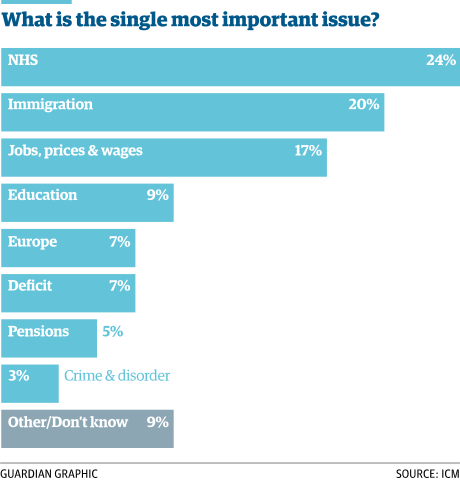
  Europe-bashing has become mainstream within British politics. UKIP have succeeded in driving the political debate sharply to the right on immigration, with the result that a recent ICM poll put immigration as the number two issue in the British political mindset - just four points behind the NHS. This has fuelled a backlash against the EU - now, even the Europhile Liberal Democrats are joining the assault against Brussels.


Right-Wing Pet Hates

  Criticism of the EU from the right-wing political establishment focuses around what is really two points - freedom of movement and human rights laws. Freedom of movement is a fundamental principle behind the European Single Market - something which David Cameron is otherwise very much in favour of - and freedom of movement of labour cannot be separated from the other three freedoms - goods, services and capital - which are essential for allowing an integrated European economy. 

  The four freedoms are also, incidentally, something which derive from the Single European Act of 1986 - a treaty which was in large part the brainchild of Margaret Thatcher, something which is a never-ending source of amusement for me as the Thatcherite parties (the Tories and UKIP) try to backpedal on one of the most important achievements of their predecessor's premiership.

  On the subject of human rights, any attempt to withdraw from the European Convention would be inconceivable. Not only is the Convention itself another fundamentally British invention - Winston Churchill's this time; not looking good for the Tories, is it? - but it would be virtually impossible to remove European human rights protections without replacing them with essentially identical British protections. The alternative is to cast in our lot with countries like Belarus and Saudi Arabia - something which no British government could do without inspiring general outrage.


What About the Rest?

  Beyond these two non-problems, the right-wing political establishment and media seem to be pretty happy with the EU as is. Yes, there are periodical requests for more money - such as that for another €2.1 billion which hit the newspapers on the 24th of October - which elicit indignation from the supporters of so-called Tory austerity, but these are fleeting objections. More or less, mainstream politicians couldn't care less about the rest of the EU's problems.

  But there are some real issues with the way Europe works. For starters, consider that the EU is a fundamentally undemocratic organisation. The European Parliament is the only EU body which is actually elected and, despite receiving new powers under the 2008 Treaty of Lisbon, is still very much the weakest EU institution. The Conservative Party, it should be pointed out,
actually opposed even these limited powers to Parliament - they would rather appointed institutions like the Commission and Coreper (the EU civil service). Some areas of policy, such as taxation and justice policy, still aren't subject to any kind of democratic scrutiny at all. Instead of wasting time attacking the basic principles of the EU, the changing of which will be neither possible nor beneficial, why don't the mainstream parties focus on this absurd lack of democracy?

  Perhaps the greatest example of the anti-democratic nature of the EU at work is the TTIP corporate power grab. This is a free trade treaty currently being negotiated, in secret, between representatives of the EU and the USA. The current proposals for the treaty include 'Investor State Dispute Settlements', allowing American corporations to sue the British government in secretive, closed tribunals for any action they take which might impact their profit margins. This would not only make renationalisation of key public infrastructure - supported by over 65% of the British public - impossible, it would also open up existing public services such as the NHS to American corporate buyouts. If the government resisted, they would be subject to legal action and crippling damages payments.

  TTIP has the support of the Conservative, Labour and Liberal Democrat Parties and even UKIP supported it until recently - abandoning the idea as soon as it became clear that there was public opposition to it, another fine example of principled UKIP policy-making. Only the Green Party opposed this dangerous treaty from the outset, along with a grassroots campaign mustered by 38 degrees (sign their petition against TTIP here). This is a clear sign if one was needed that the mainstream political parties don't really care about the sovereignty of the United Kingdom, just clinging on to their own positions of power.


Conclusions

  The European Union was a fantastic idea which has gone badly wrong. Anti-democratic organisational features and economic incompetence have led what should have been a wonderful experiment in international peace and co-operation into a deepening crisis, while TTIP threatens the very economic sovereignty of its members. UKIP's solution to the problems of Europe is to jump ship; my preference would always be to push for reform first, but what is clear is that the establishment parties will not tackle the real issues with Europe, so obsessed are they with chasing UKIP's right-wing narrative over immigration and human rights laws. As usual, it's up to us - the people - to force the idiots and self-serving careerists who rule us to take the right course. Don't hold your breath.

Thursday, 10 April 2014

No Such Thing as Society?

  When Margaret Thatcher uttered those now-infamous words in an interview with Woman's Own journalist Douglas Keay, she did not mean quite what many assumed she did. The gist of the wider context of that statement was that society was not some giant, conglomerate entity in and of itself - rather, it was made up of individuals and families living together and that the actions of individuals dictated how 'society' functioned.

  But unfortunately the late Mrs. Thatcher seems to have been blessed, if not with the gifts of diplomacy, tact or indeed economic understanding, then with a supernatural prescience. Society at the time of the statement - 1987 - was still relatively intact, though hard-pressed by the introduction of neoliberal economic doctrine. Today, however, this is no longer the case.

  The post-Thatcherite consensus - in place in the UK arguably since 1983, and certainly since 1995 - is the general acceptance between the major political parties that a free market economic model - with private control of industry, low taxation, limited state spending, reduced welfare provision and deregulation of the economy - is fundamentally a good thing. 

  The four largest political parties in terms both of membership and votes at the last general election (Conservative, Labour, Lib Dem and UKIP) all basically follow the same economic policy. There are small differences, placing the parties on a continuum - UKIP are the most neoliberal, Labour the least - but all four are basically in agreement on the core tenets of economic policy.

  The consensus among the main parties means - short of a seismic shift in UK politics - neoliberalism is set to remain the guiding economic ideology in the UK for some time to come, but the social impact of this model is extreme and highly damaging. The idea of neoliberalism is that a deregulated economy with minimal state interference will allow competition to flourish, driving the market forces to create masses of wealth. This wealth will be concentrated at first in the hands of large corporations and the individuals who run them but, over time, expenditure by these big beasts will cause that money to 'trickle down' into the rest of the economy and everyone else benefits too.

  All sounds very reasonable, doesn't it? The problem is, it doesn't work. 

  Or rather, stage one works sublimely well. A deregulated economy does indeed allow large corporations to generate huge amounts of wealth, and the CEOs and major shareholders of these companies do very well as a result. But the 'trickle-down' effect simply does not happen. Last year, the top 1% of earners in the UK took in 10% of total income, whilst the bottom 50% received only 18%. A recent report by Oxfam revealed that the five richest families in the UK own more wealth than the poorest 20% of the population. Clearly, the money is being generated at the top and staying there.

  And this causes a polarised society. Politicians on the economic right often accuse those on the left of promoting class warfare when they talk of the redistribution of wealth and the equalisation of society. But it is the neoliberal economic system imposed by the right, and accepted by the traitorous so-called Labour Party, which creates the classes in the first place. Inequality in the UK today is higher than it was before the First World War. In light of that, of course those at the bottom of the economic hierarchy are angry with those at the top. Why shouldn't they be?

  Not only does neoliberalism affirm and enhance class distinctions, it also splits society along racial lines. It is the failure of the neoliberal economic system which caused the financial crash of 2008. In the aftermath of that crash, right-wing parties with strong anti-immigration and openly racist rhetoric have been going from strength to strength all over Europe. Why? Because, when money is scarce, people want to ensure that the pool of people competing for resources does not grow any larger. It is difficult to blame the average UKIP voter for being concerned, even scared, of immigration when money is so tight and immigrants represent more competition. Thus, the right creates social problems with its economics and then exacerbates them by offering false solutions.

  Then there's the obvious - poorer people means more crime. By increasing inequality, neoliberalism creates an underclass - a group characterised by chronic unemployment, low standards of living and high crime rates. When you have nothing, or next to nothing, you will be more inclined to steal in order to get more - or alternatively, to blow what you do have on drink and drugs to escape the ordeal of life. Neoliberal economics are largely responsible for much of today's crime and increased drug and alcohol dependency. They also must bear some of the blame for rising suicide rates, particularly among the high-risk category of middle-aged men who find themselves unable to support their families due to inability to find decent work.

  In short, neoliberalism promotes greed, disincentivises altruism and co-operation, polarises society along class and ethnic lines and contributes to the creation of an underclass which is then demonised by the press and systematically purged by government policies. Margaret Thatcher was not passing judgement when she made her famous statement, she was making a prediction. A prediction her government, and every government since, has helped to fulfill.

  About time we did something about it. 

Wednesday, 1 January 2014

I Agree With Nigel Farage

  Well, that's a sentence I don't utter very often. As a general rule, I respect Mr. Farage for being one of the few politicians in modern Britain willing to speak his mind, but I rarely agree with those impassioned outbursts that he does so well. On the issue of Syrian refugees, however, some surprising common ground has at last emerged.


  Such a rare event, I thought it justified a blog.

  Because, like it or not, Nigel is making some considerable sense. UKIP grassroots members have lambasted him for allegedly 'giving in to the liberal media' and abandoning his anti-immigration stance by joining the growing voice putting pressure on the government to accept some of the exodus from the terrible Civil War that has torn Syria apart. They argue that it is madness to oppose the influx of Romanian and Bulgarian migrants which many on the right have predicted (but which doesn't seem to have materialised just yet) and at the same time open the UK's arms to thousands of Syrian refugees. On the face of it, this does seem a little hypocritical, but when you think about it it's actually entirely justified.

  Farage and his party oppose economic migration. They are the respectable voice of the significant minority of the British working and lower-middle classes who see immigration as a mechanism by which foreigners come to the country and steal jobs from British workers. But, as the man himself has pointed out, Farage's latest plea is not at all at odds with his main objective, because the Syrian refugees are emphatically NOT economic immigrants. They are desperate people fleeing for their lives from a brutal conflict which has engulfed their homes. 2.4 million desperate people - and the government stance is that not a single one may pass the UK borders.

  Clearly, we cannot take them all - that WOULD be madness. As much as we may wish it were otherwise, the UK does not have the economic infrastructure to accept such a large number of destitute people so quickly. If they were economic migrants, it might be different, but that's another matter entirely. These people will be starting in this country from nothing, and the level of support they will require to survive and thrive here will be too great to admit such large numbers.

  But not to take any? That seems callous in the extreme.

  The EU as a whole has spectacularly failed in its moral duty under the 1951 Covention on the Status of Refugees to help the people of Syria survive this war. 28 member states, covering almost 1.7 million square miles of territory, and we have collectively welcomed just 12,340 refugees. This is a pitiful amount by any standard, and yet even Spain's paltry contribution of 30 places is generous compared to the UK. We are offering nothing. Precisely no places at all. Those UKIPpers who have derided Farage for his humanitarian stance on this issue would probably be the first to revel in the nostalgia of the 'good old days' of 'Great' Britain. But when the UK has failed to match even Germany's modest intake of 10,000, how can this country possibly claim to be anything more than a second-rate backwater power falling rapidly behind the front runners in the race for the twenty-first century?

  If we want to prove that the UK still has the capacity to affect the world around it, and for the better for a change, then the best thing to do is to agree to take in a portion of the persecuted diaspora of humanity that the cruelty of the Assad regime has caused to be exiled from their homes. 

  And what of Farage's suggestion that those we do take be limited to Christian Syrians, a persecuted minority composing about 10% of the population? This is a more difficult topic. We should be instinctively wary of favouring any one religious (or, for that matter, non-religious) group over another in the allocation of asylum places. Certainly, the days when the UK was a Christian-dominated society have long since passed. However, Farage's argument that Sunni and Shia refugees have a number of far more local countries whose official religions follow those faiths, whereas Christians living in Syria have nowhere nearby to go does have some merit. It is true that the persecution of the Christian minority in many parts of the Middle East means that local asylum is not necessarily an option. In such a case, shouldn't western nations whose attitude towards faith is more liberal offer them succour?

  One solution to the problem would be an international organisation for resettling displaced people, which could then ensure that the refugees are distributed fairly among nations and only relocated to countries where they will not face further persecution. In the meantime, the political dangers and moral difficulties over restricting asylum to Syrian Christians means that the best option is to take the refugees as they come, perhaps giving priority to those not of the Islamic faith but not ruling out Muslim refugees. 

  One thing is clear though - however we choose to progress, the UK must do more to help the Syrian people, as must those other Western countries whose governments opted not to offer any asylum places at all. If not, we risk sacrificing what little credibility we have on an international stage, particularly in the Middle East itself. The West has already begun two destructive wars in the region, and is responsible in no small part for the instability that now plagues it. We have now a chance to redeem ourselves, if only partially. Fail to take it, and the diplomatic consequences will be dire.

  The human cost of failure is simply too awful to contemplate.
google-site-verification: google3c44c0a34dc56f57.html