Sunday, 12 October 2014

Chart Music - How Bad Can It Be?

Pop music in 2014 is frequently slated as generic, bland, meaningless rubbish. Is that fair? Let's find out...

  Those who know me at all will know my musical tastes are not attuned to those of the 21st century zeitgeist. My passion is, and has always been, for what are rapidly becoming niche genres; hard rock, punk rock, heavy metal, grunge - these are the styles of music which I love, but I'm under no illusions - they aren't exactly what's getting played on Radio One. As a rocker, I have entered into more than my fair share of slating modern pop music - this article, for example - but have I been entirely fair? 

  In the interests of science - as well as (hopefully) proving myself right to shun the chart-toppers of today - I have set myself a challenge. Five songs - the top five on the Official Chart Company's most up-to-date list - get one playthrough each. I shall be as objective as possible - i.e. not very. Let us take the plunge...


  First things first: Autotuned to all hell. I know this is pretty standard for modern pop tracks, but it is used far too heavily here. The chorus is catchy, there's no denying that - this is one I have heard before, and it does worm its way inside your head - but more or less meaningless. it does work as a hook, though, and the rest of the lyrics are fairly pointed. 

  The overall message of the song - that people (specifically women) should be less concerned with their weight and physical appearance - is unquestionably a good one (provided they do not become unhealthily overweight, of course), but Trainor does fall into the all-too-common trap of countering the media-fuelled obsession with being thin with an overt sexualisation of women's bodies which, to me, rather misses the point. Surely it should be possible to encourage women to care less about their dress size and attack the misogynistic culture of women as sex objects? Evidently not.

  Still, at least the artist actually had a hand in writing the lyrics, and the instruments were all played by the track's producer and co-writer (Kevin Kadish), making a refreshing change from the usual assembly-line construction of pop tracks. Overall, it could have been a lot worse and I'm glad that the no. 1 spot is filled by something which at least has a message to it.


  The video is more or less the polar opposite of Trainor's offering, glorifying the so-called 'beauty' enshrined in being super-thin. It is characteristic of the general dichotomy of the modern world that these two tracks can both be at the top of the charts at once. The hook is undeniably well-crafted to be as catchy as possible, but the lyrics are more or less uninspired - the singers desire to copulate with an unnamed fourth party. There isn't anything more to it than that.

  The track is carried by Jessie J (real name Jessie Cornish)'s voice - it is, I have to admit, strikingly powerful, if ill-used. Grande's, meanwhile, is nothing more than mediocre (even with a generous helping of autotuning) and why Cornish chose to include Nicki Minaj - possibly the worst rapper currently in existence - in this project is beyond me. If the abysmal rap segment were to be removed, the R&B-influenced pop tune which would be left would be passable. As it is, my poor ears urge me never to listen to it again, and I think I shall acquiesce.


  Aptly named.

  Yes, the lyrics are repetitive and I think that if I ever here the words 'I shake it off' again I might cry, but the sentiment is at least admirable - sod the bastards, I'll do what I want. A welcome departure from whinging about her ex-boyfriends, it must be said, though the musical style chosen is something of a step in the wrong direction. Swift is an artist for whom I have previously had very little respect, but this latest offering - when boiled down to its key message - is something I can at least relate to. Now, stick some guitars in the background, swap that trombone for a saxophone and ramp up the percussion a few notches and I can feel a bit of a ska-punk classic in the offing. No? Perhaps not. In any case, its a marked improvement on the last one, but my faith in humanity has not yet been completely restored.


  This is more of a Paloma Faith featuring Sigma track, to be honest. It's been a while since I heard a proper drum 'n' bass track - dubstep, house and trap seem more the go-to dance genres these days - and frankly, this isn't it. Faith's vocals are soulful and quite strong, but that's the problem - the actual drum 'n' bass element of the song is completely overwhelmed. This is no Propane Nightmares - but then, Sigma are no Pendulum. Not even close. If you want drum 'n' bass, give In Silico a listen. If it's dance music in general, The Prodigy exist for heaven's sake! 

  Take this as a Paloma Faith soul ballad, and it's just a fairly mediocre song by a slightly-above-average singer, devoid of much meaning or lyrical depth. Take it as a drum 'n' bass record, and it's not even worth your time.


  Pretty standard electronic dance fare. You could certainly dance to it, and if that's all we're looking for in what is admittedly a dance track, we can leave it there. However, I like a little more in a song - I've moshed to Cry For the Indians, but that also has a powerful message of its own, so why can't I dance to a track which has one? Blame certainly doesn't - while Newman's vocals are passable, the lyrics are dull and repetitive, and don't really gel with the upbeat tempo of the music. 

  
  There we go, all done! That was a long five songs, but an interesting experience. From this little experiment, I think we can gather three things: One, that pop music can have a message, but that it all too frequently doesn't; Two, that overall the charts aren't entirely devoid of musical talent - just mostly; and Three, that now Queen have come on Spotify and I feel much, much better.

Friday, 10 October 2014

UKIP - The Purple Menace?

Does UKIP's performance in Clacton and Heywood & Middleton mean the 'big three' are in serious trouble?

Carswell's Triumph

  Douglas Carswell's crushing victory in the Clacton-on-Sea by-election should come as a surprise to precisely no-one. The seat was described as the most-UKIP friendly in the country, Carswell had a huge personal following - demonstrated by the mass exodus from the local Tory association to his UKIP branch - and the UKIP propaganda machine has been working overtime ever since the by-election was called.

  However, the sheer scale of the victory - 59.7%, a rare majority, with the jump from 0% (UKIP did not previously contest Clacton) the biggest in by-election history - should of course be noted by anyone with an interest in the growing right-wing force. As birthday presents go, this one is probably not David Cameron's best. Carswell did not just beat the Tories, he thrashed them, and such a result will be invaluable to UKIP come 2015.


Miliband's Nightmare

  Of course, Clacton was not the only by-election result to be announced during the night - Heywood and Middleton also voted, and they voted to keep Labour in power. However, UKIP came deadly close, with just 617 votes between the two. The Labour victory is important for the party - failure to hold the seat would have been another nail in the coffin of Miliband's leadership - but the significance of this close call is huge. Farage has long proclaimed that UKIP has a broad-based appeal, attracting defectors from each of the traditional 'big three', and the near-success of the party in this northern, working-class constituency - seat of former Labour Prime Minister Jim Callaghan, no less - seems to confirm that.

  Of course, the Labour party line is that the UKIP surge was driven mostly by the collapse of the Conservative and Liberal Democrat votes, and the nose-dive in turnout to 36.2%. This is quite probable, but that does not excuse the Labour failure to capitalise on this collapse. Anti-UKIP tactical voting should have lent weight to the only party in the seat with a reasonable chance of defeating them, and yet the margin of victory remained pathetically small. Some UKIPpers are calling for a recount, and the party's candidate John Bickley stated that “I’m under no illusions. Another two or three days and we would have won this.” Such a delay would have put the poll in the wake of Clacton and the UKIP landslide there - Bickley is probably right.


Same Old Party?

  Winning an elected MP for the first time, and their second ever UKIP MP overall, will lend a legitimacy to the party that their 24 MEPs and 370 Councillors could not do. So Westminster-focused is British politics in the 21st Century, only a UKIPper in the House of Commons would do to persuade some sections of the establishment to take them seriously. Despite Conservative HQ's line today that people will not vote for 'alternative' parties come 2015, even the most traditionally self-confident Tory must now admit that UKIP are a threat.

  The question is, what do UKIP represent - and is it something the British people will ever vote for en masse? The label 'fascist' has been applied to the party in the past and, whilst it is an exaggeration, there are some fascistic elements to the organisation. They can be seen in the party's de facto English nationalism; in the veneration of a single charismatic individual as leader; in the party's corporate backing; and in the appropriation of the odd traditionally left-wing policy in order to garner populist support.

  Glimpses of UKIP's more unsavoury aspect are also revealed by those of its members less willing to toe the party line. Though the sagas of Bongo Bongo Land and storm-causing gay marriage are beginning to recede into the past now, these kinds of people are still present in the party - just masked by an increasingly effective and media-supported propaganda machine. The fact that the blatantly and pathetically prejudiced Alan Craig, former leader of the hard-right Christian People's Alliance, has defected to UKIP and campaigned for them in Clacton - this a man who equates equal marriage with child abuse - and that UKIP has defended him demonstrates quite clearly that, however much it may have appeared to move on, the party is still stuck exactly where it was ten years ago.

  
  Will UKIP do well in 2015? Almost certainly. Will they increase their vote share? Undoubtedly. Will they pick up a handful of extra seats, the better with which to harass the Tories in Parliament? Quite probably. But will they ever become a force which the people of the UK will select to represent them on a national basis? I doubt it. Not without quite a considerable reformation of the party and a purge of those less salubrious elements within its structure.

  Meanwhile, are they a threat to the 'big three'? The by-elections of the 9th of October tell us, absolutely. And, much as I despise UKIP itself, upsetting the cosy establishment apple-cart can't be an entirely bad thing.

Tuesday, 30 September 2014

The Brooks Newmark Sting - Journalistic Integrity?

  First things first, I'm glad that Brooks Newmark MP - Conservative Member of Parliament for Braintree - has resigned as Minister for Civil Society. Having stated that, as the minister responsible for charities, his plan was to 'keep... [them] out of the realms of politics' and that they 'should just stick to their knitting', there was absolutely no question that this man was unfit for office. 

  Bad enough that the Tories have already steered their charity censoring 'Gagging Bill' through Parliament, with the Bill - ostensibly aimed at lobbying organisations but in fact doing very little to contain the worst offenders - now an Act of Parliament (incidentally, there is another Bill before Parliament aimed at repealing this repulsive law - please consider writing to your MP to vote for it). Newmark's comments, in the wake of this outrage, merely drove home the contempt in which the Tory elite hold the populace, and the charitable organisations who are among the few groups with any power acting on their behalf. Yes, Newmark had to go.

  But not like this.

  The idiocy of the man in falling for the oldest trick in the book - random sexy stranger sends alluring photos and flirts; because THAT'S likely to happen to a 56-year-old Tory MP  - is without question. And, frankly, I quite enjoy the panic that losing an MP and a Minister on the same day must have inflicted on the Tory high command. But, in the end, isn't it his business? Why are we in a situation whereby the most appalling comments about the organisations with which it is part of a minister's job to liaise are not grounds for resignation, but a little ill-advised cyber-flirtation with another human being is? 

  It is, then, a matter of the public's own warped sense of morality - one which years of neoliberalism has stripped of most positive qualities, but which still holds on to good old-fashioned  social conservatism - which has allowed this curious and, honestly, disappointing dichotomy to arise. But more than that, it is a matter of journalistic integrity. Or rather, of the complete lack of journalistic integrity shown by one Alex Wickham.

  Wickham writes for Paul Staines' Guido Fawkes blog, as well as doing freelance work for other newspapers. His use of the photographs of two young women (which were, I might add, obtained and then widely published without consent) to ensnare Newmark in this way was reprehensible. Ignore the fact that this man was obviously unfit for ministerial office, because Wickham would not have cared either way either, and you are left with the destruction of a man's career over a few moments of indiscretion. 

  The following are clear: Newmark should have resigned weeks earlier, taking care of the problem; Wickham should not have stooped to these lengths just to secure a story; and the Sunday Mirror certainly should not have published this sensationalist nonsense (but then, it is the Sunday Mirror; we shouldn't expect miracles). None of these things happened, and thus the common public opinion - that politicians are without scruples and journalists are little better - is, sadly, once again borne out.

Saturday, 27 September 2014

Here We Go Again

  MPs in the House of Commons yesterday voted by 524 to 43 in favour of UK airstrikes against IS targets in Iraq. Ladies and gentlemen, here we go again. Barack Obama last week became the fourth successive US President to declare on live television an American bombing campaign in the Iraq region; now, David Cameron joins him in declaring military action in the failing state just three years after the last British forces withdrew from the country.

  War in Iraq seems to have become something of a hobby for the Anglo-American military-industrial complex. This time, though, we are not fighting the iron-fisted tyrant that was Saddam Hussein - instead, the enemy is a group of ultra-radical fundamentalist Islamists; a group whose interpretation of the Qur'an combins the worst evils of the early campaigns of bloodshed emanating from seventh-century Medina and more modern Wa'habist ideologies of an ultra-strict religious conservatism and adherence to a twisted brand of Sharia law. A target, therefore, one might think worthy of Britain's aggression? Perhaps.

  The problem is, though, so much of the current problem is derived directly from the Iraq War of 2003 and the earlier Gulf War of 1990. Despite the protestations of senior government figures to the contrary, blowback from overseas theatres of war is a real and present problem, and the history of modern British and American involvement in the Middle East is scarred with it. From the Afghan campaigns of the 1980s, which kickstarted the rise of the Taliban, to the brutal murder of Drummer Lee Rigby last May - whose perpetrators explicitly stated their aim as revenge for slaughtered Muslims in Iraq - the US-UK alliance is dogged by bloody reprisals against their people for the governments' actions abroad.

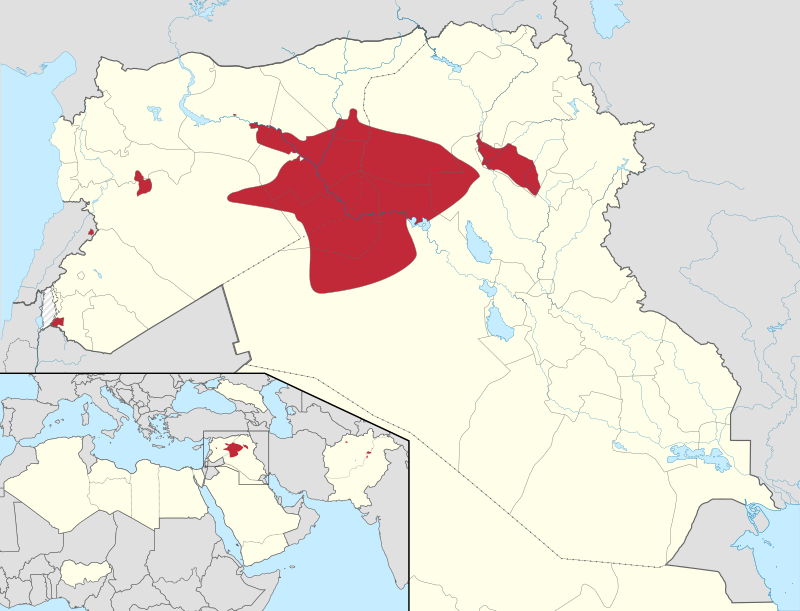
The territory controlled by the IS as of 22/09/14
  The success of the Islamic State, formerly an al-Qaeda offshoot, is based to a not inconsiderable degree on the violent actions of Western powers in the Middle East over the last half-century or so. The Arab Spring may have destabilised the region enough for ISIS to emerge in Syria, but it has been the justified hatred of Western interventionism which has helped to fuel its transformation from one of many small rebel groups set against the Assad regime to a de facto independent country straddling the borders of two of the regions former powers, and it is the weakness and sectarianism of Iraq in the wake of the Alliance's disastrous earlier invasion which has allowed the armies of Islamist extremism to run roughshod across the lands once home to the greatest civilisations on Earth.

  So, here we go, back into Iraq. So far the UK - along with the other European powers participating in the action (Denmark and Belgium) - are loathe to expand operations into Syria, but now that the USA has taken that step, in defiance of Assad's protestations of illegality, it can only be a matter of time. This war will be one without borders, one which Cameron has said could take three years but which could easily last five times that. Another war in an unstable area, and what will we be left with at the end of it? Two shattered states, a Middle East infected with a stronger poison of religious extremism than ever before and greater and greater hatred for the 'Great Satan' of Western intervention.

  And that's assuming we even win.

Friday, 19 September 2014

It's All Over - Except It's Not

  Well, there we go. That's that, as they say. Scotland, land of haggis and whisky (of which I'm fond) and of bagpipes and tartan (of which I'm not so fond) has voted in what was probably the defining moment in recent British political history. The result, a 10-point win for the No campaign, on the back of a turnout of 84.6%, is not the vast thrashing of the Independence campaign which was predicted when the referendum was called, but it is a significant enough margin to settle the question for some time.

  But, I'm afraid, that's not quite the end of it. In fact, not by a long shot. It has been clear for some years, and most especially for the last fortnight or so, that the status quo simply will not be acceptable to Scotland for any longer. The fallout from the referendum will send shockwaves through Scottish politics, and it will profoundly affect the rest of the Union too. The Scots may have gone for No, but this emphatically doesn't mean No Change.


Scottish Devolution

  With the current Devolution plans under the Scotland Act 2012 lay out some powers which will be transferred to Scotland over the next two years. These include a replacement of UK Stamp Duty by a Scottish version, the ability for the Scottish Government to borrow from the capital markets and issue government bonds and - crucially - the cutting of the UK Income Tax in Scotland to 10%, with the Scottish Government responsible for setting a separate rate to make up the shortfall, which would allow Scotland to vary overall Income Tax rates from the UK standard of 20%. 

  Let's be clear, these powers are to go to the Scots, regardless of what happens over the next few months. However, there are now proposals on the table for new Scottish powers from each of the three main Westminster parties. These new powers will be needed to assuage the demand for greater autonomy which 1.6 million votes for independence demonstrates. There are differences between the parties on what these powers should be, however.

  Labour Proposals   [SOURCE: Scottish Labour Devolution Commission - Executive Summary]

  • The Scottish Parliament to be made a permanent feature of the UK constitution
  • The Scottish Parliament to have administrative authority over Scottish Parliament elections
  • The Scottish Government to raise approx. 40% of its own tax revenues
  • UK Income Tax rate in Scotland to be reduced to 5% rather than 10%
  • The Scottish Government to be able to vary different Income Tax bands by different amounts
  • Retention of the Barnett Formula for the Scottish block spending grant
  • Housing Benefit to be devolved to the Scottish Parliament
  • Greater powers for the Island Communities - Orkney, Shetland and Eilean Siar

  Conservative Proposals   [SOURCE: Commission on the Future Governance of Scotland]

  • Income Tax entirely devolved to the Scottish Parliament
  • Official Scottish Fiscal Commission to be established
  • Possible devolution of Housing Benefit
  • Possible ability for the Scottish Parliament to supplement UK social security payments
  • Retention of the Barnett Formula for the Scottish block spending grant

  Liberal Democrat Proposals   [SOURCE: Federalism: the best future for Scotland]

  • Power of Initiation, allowing the Scottish and Westminster Parliaments to request actions of one another
  • Devolution of Income Tax to the Scottish Parliament
  • Devolution of Inheritance Tax and Capital Gains Tax
  • The proceeds of Scottish corporation tax to be assigned to the Scottish Government
  • Retention of the Barnett Formula for the Scottish block spending grant until a new formula is agreed
  The rhetoric generally is that Labour's proposals are the least extensive, but this is mainly focusing on the slightly weaker offer on Income Tax. In fact, overall it is clear that it is the traditionally Unionist Tories who have made what I would consider the least attractive offer. For a new devolution settlement to work, though, all three parties will have to agree a package of powers, which will then have to be agreed with the SNP. The man in charge of this process is the Lord Robert Smith, Baron of Kelvin, who also ran the Glasgow Commonwealth Games earlier this year. A White Paper is planned for January. Watch this space...


Winners and Losers

  The big loser of this referendum has been Alex Salmond. Despite cutting No's lead from 22 points two months ago to just 10 in the referendum, Salmond has announced his decision to step down both as SNP leader and First Minister of Scotland in November. This leaves the way open for his popular deputy, Nicola Sturgeon, long tipped as his sucessor to take the reins of power. With so long under Salmond, this could prove a real shake-up for the Scottish Nationals.

  The biggest sigh of relief was likely breathed by David Cameron, for whom a Yes vote could have meant a vote of no confidence in the commons and the loss of his premiership. Ed Miliband, too, was likely a little anxious in the run-up to this vote, as a failure for Better Together would likely have been seen as a failure of Labour to successfully challenge the SNP - and thus a damning indictment of his London-centric leadership. Both major party leaders were staring down the barrel of a gun pointed straight at their careers; the No vote has saved them. For now.

  The star of the show, though, has undoubtedly been Gordon Brown. Alistair Darling's leadership of Better Together has been criticised for his lack of charisma and failure to stand up to Salmond, but Brown's fiery eve-of-referendum speech appeared to more than make up for that. It is hard to say just how much his intervention contributed to the eventual success of the No campaign, but calls for the ex-Prime Minister to return to front-line politics after more than four years - perhaps as leader of Scottish Labour - demonstrate how much public opinion he has won by speaking out.


What About the English?

  Almost as soon as the No result was clear, prominent English politicians began their calls for English devolution to match the Scots. Both David Cameron and Ed Miliband mentioned the so-called West Lothian Question in speeches today - Why should Scottish MPs, with significant and growing powers over Scotland now in the hands of the Scottish Parliament, continue to vote on English matters at Westminster? - with Nigel Farage among the many others taking up the cry.

  The Conservative backbenches are pushing for 'English votes on English laws' within the current Westminster Parliament, a solution which would settle the question in the short term. However, Labour - who would find it difficult to get approval for their English agenda under such a system, given their partial reliance on Scotland and Wales for their Parliamentary majorities - are going to take some convincing. Meanwhile, the more interesting - and controversial - question of an English executive, complete with ministerial departments and a possible First Minister of England, has also been floated. Whatever happens, one thing is clear - England will not be satisfied with the status quo either.


  It is clear, then, that a No vote in Scotland does not mean that the leaders of the Westminster parties can rest on their laurels. Independence may have been rejected, but change is coming to the UK - and not before time, either. 


[NOTE: A previous version of this article stated Alex Salmond was unlikely to step down as SNP leader. He announced his intention to do so while I was finishing writing this piece. That'll teach me to make predictions]

Tuesday, 16 September 2014

Scotland's Choice; Everyone's Future

If Scotland chooses independence this Thursday, the outcome will affect us all

  
  I have been (for me) relatively quiet on the issue of Scottish independence. This is because I believe fundamentally that the decision rests with the people of Scotland itself, and that the interjections of non-Scots - particularly residents of southern England, like myself - are hardly helpful to the debate. 

  The fact is, though, that in two days a very large decision is about to be taken by a comparatively small number of people - just under 4.3 million people, or just 6.7% of the UK's population. The result of that decision could well be the splitting of a 307-year-old union between the Kingdoms of England and Scotland (sorry, Wales, Principality and all that); indeed, such a result is looking increasingly likely, with the average No lead over the most recent 10 polls at just 1.9% - well within the three-point margin of error for a standard 1,000-person poll - and the momentum of the debate having been clearly on the side of the Yes campaign for a good month now.

  If Scotland does vote Yes, things will change for everyone in the UK, not just those living in Scotland. Here is a quick, and by no means exhaustive, rundown of some of the biggest issues that will affect us all:


The Pound

  It may have been done to death over the course of this long, long campaign, but this is still one of the biggest unresolved issues of the whole independence question. Alex Salmond, Blair Jenkins  and the Yes campaign maintain that the Pound belongs to Scotland too, and they will keep it come what may, but that's not quite true. The Pound Sterling as a currency is the responsibility of the Treasury and the Bank of England, and if the new Scottish government want a currency union, they would have to negotiate one with the UK. 

  Of course, they could just use Sterling on an unofficial basis - Zimbabwe already does, along with numerous other currencies - but they would then have no say over its value and would have to match rUK interest rates or risk economic collapse. It is likely, then, that Scotland will push for a Sterling Zone - but this would mean maintaining Scotland's economic ties to the UK central government. It would also mean allowing Scottish input into decisions over rUK monetary policy, which could alter the value of the currency in England, Wales and Northern Ireland as well.


The National Debt

  As of the end of June, the UK national debt stands at £1,304.6 bn (not including the cost of the  2008 financial sector bailouts). The total population of Scotland is 5.3 million as of the 2011 census, compared to the UK population of 64.1 million. This means that Scotland's 'share' of the debt comes out at 8.27%, or £107.9 bn. Trouble is, much like the pound, responsibility for the UK debt also rests with the Treasury - meaning Scotland doesn't legally have to take any of it.

  Alex Salmond will use this as a powerful bargaining chip in the post-referendum negotiations - most likely he will offer taking a share of the debt in return for his Sterling Zone. If those negotiations fall through, however, the rest of the UK will be left with a considerably greater per capita debt than before. This, under the current neoliberal consensus, means only one thing: more cuts.


The Border

  At the moment, of course, the border between England and Scotland is merely ceremonial - there's a sign, a bit of crumbling Roman masonry and not much else. Post-independence however, that could change. In order to meet projected levels of spending, particularly with regard to pensions, Scotland would need to attract an estimated 20,000 additional immigrants a year over the next 20 or so years. Contrast this with Westminster's increasingly anti-immigration rhetoric, and you can see the problems an open border would cause.

  Ed Miliband has already floated the idea of border guards along Hadrian's Wall, but this would have far-reaching consequences for people on both sides of the border. Travel would be inhibited, slowing down the process of moving goods and services across the newly concrete divide. Coupled with possible currency issues, and an almost inevitable discrepancy in taxation policy, this could make conducting business across the border - a simple fact of life for centuries for those living in the border regions of both Scotland and England - more and more difficult. A closed border will also affect the Scottish tourism industry - rUK tourism is worth £3.7 bn to Scotland every year, 2.8% of GDP. The economic damage to both countries could be significant, particularly for those close to the border.


National Institutions

  Many of the UK's most prominent institutions are run on an all-UK basis. These include things like the NHS, the BBC, the armed forces etc., and of course the British Civil Service itself. The breakup of the UK would lead also to the breakup of these institutions - Scotland would need its own army, health service and civil servants, whilst the future of the Scottish BBC might well be in jeopardy altogether. Though many institutions, particularly the NHS, are already decentralised to some degree, there is still a colossal amount of interconnection, and a wholesale restructuring of these organisations and many others would have to take place. The cost of this will be huge - estimates for setting up a new Scottish civil service alone range from £200 million to £2.7 billion - and it will be felt by both new states.


  Whatever decision the Scottish people take this Thursday, nothing in the UK will ever be the same again, but the effects of independence - should it be chosen - will be perhaps the most dramatic in living memory. This week may seem ordinary now, but in twenty, fifty, or two hundred years time it could well be one of the most studied in British history.

Monday, 11 August 2014

An Unstable Union

Scottish independence or no, something needs to be done to save the UK


  I've said before that decentralisation away from London is essential if we are to prevent the disintegration of the United Kingdom as we understand it. The forthcoming referendum over the future of Scotland is testament to the damage to a country's cohesion that extreme and extraordinary concentration of wealth and political power in one place can do.


The Questions of Independence

  We stand at a crossroads, in terms of the UK's future. Whether Scotland chooses independence or not, the next five years will have to see huge changes in the economic and political balance of our country. In the case of Scotland's departure, we will of course have to face the question of how to manage the divvying up of resources, currency and other assets, as well as the country's debt; but we shall also have to look at the question of what level of political union between the new Scottish Kingdom and the rest of the UK shall remain - for to sever all ties would be almost unthinkable.

  Questions would also be raised about the stability of 'rUK', as it has been stylised - if Scotland goes for independence, what of Wales, Northern Ireland, the Crown Dependencies? What about Cornwall, or Yorkshire, where support for greater autonomy within the UK is already significant? The thing is, though, that even if Scotland chooses to remain part of the UK - as the polls currently suggest it will - these questions still need answering. The temptation in Westminster and Whitehall, should Better Together claim victory in September, will be to palm the Scottish Nationalists off with a few extra tax-varying powers, breathe a collective sigh of relief and prepare the laurels for resting.

  This must not happen.


The Challenges of Union

  The reason this referendum is being held, the reason there is such significant support for it (39% in the most recent poll at the time of writing, when 'don't knows' are excluded), the reason Scottish Nationalism was ever able to grow beyond a minority of dewey-eyed nostalgia-merchants clinging to the memory of Bannockburn like a comfort blanket, is this: Scotland IS being marginalised, because the whole of the UK outside Greater London and (to a lesser extent) the rest of the South-East of England is being marginalised.

  It is clear that for the UK to continue to function, not only the Scottish Parliament but also the Welsh and Northern Irish Assemblies must be given not just token powers but a real ability to pursue their own policy programmes within the UK. It is a clear and well-documented fact that political preferences differ within the constituent countries - Scotland and Wales tend towards the centre-left, whilst England has since the 1980s been firmly right-wing and Northern Ireland is torn almost in two between the centre-left and the hard-right. It makes little sense, therefore, to force these nations to live under one rigid set of common rules. Far better to adopt the principle of subsidiarity - what can be done by individual constituent countries, and indeed by regional authorities, should be, with the central UK government acting only where it is more effective to do so.


A Programme for the Future

  Fixing the UK's constitutional crisis will not be easy, and there are many details which need to be addressed, but there a few things which need to happen before any real progress can be made:

  • An English Parliament, with powers equivalent to the Scottish Parliament
  • The Welsh and Northern Ireland Assemblies to be given equal powers to the English and Scottish Parliaments
  • All four constituent countries to raise their own revenues through individual rates of corporation and income tax, with a separate UK-wide tax to fund the central government
  • Strengthened County Councils, with powers over health and education within their borders
  • Central government infrastructure projects to focus on bringing all transport links up to the standards of South-East England
  • Provision made for County Councils to offer financial incentives to businesses to relocate away from London in order to boost regional economies
  By spreading political decision-making and economic wealth more widely and evenly, the foundations can be laid for a more equal UK which does not disadvantage geographic distance from the capital. The problem is, none of the established parties are willing to support such measures - they gain too much from the London-centric status quo. Without reform, however, Scotland - even if it chooses to stay this time - will be having another referendum within a few years, and other parts of the UK will follow. No matter if Scotland stays or goes, if nothing is done to rebalance the UK, there will be trouble.

Thursday, 24 July 2014

Israel's Holocaust

  Back in March I wrote an article on Israel's heavy-handed response to what was then the most recent bout of Palestinian rocket fire into the Jewish State, and the pressing need for talks to take place for a two-state solution. It is now July, and the past three weeks have seen a resurgence of the decades-old conflict on a scale not seen since the pre-Israeli election massacres of Dec '08-Jan '09. 


How Things Stand

  Before we turn to my analysis of the situation, let's have a look at the numbers. Bear in mind, the latest bout of violence - christened Operation Protective Edge by the IDF - began on 08/07/2014.


  I hate to have to reduce the deaths of real people to mere statistics like this, but the volume of casualties is simply too high to go into details (although the Telegraph has created a thought-provoking spread showing the names and ages of each dead Palestinian child). Each of these deaths - all 806 of them - is a tragedy. But these killings are no accident. They are a result of the policy of Benjamin Netanyahu's government towards Gaza - that it is the stronghold of Hamas, and as such its people are legitimate targets. 

  Netanyahu and his cronies don't seem to care how many civilians or even children die - as long as they pick off a few Hamas fighters. The fact that well over three-quarters of all Gazan casualties have been non-combatants does seem seem to even register - the tanks keep rolling, the missiles keep coming. The deaths keep mounting up. Seventy-six people have died today. 


Netanyahu's Purpose

  The word 'Zionist' is a loaded one. Those who decry Israel's government as Zionist extremists are often accused of being anti-Semitic, but the claim is perfectly legitimate. Zionism is, at its basic level, simply the belief that the State of Israel should exist in its present location. This, in an of itself, is not a particularly extreme view. But Netanyahu's party, Likud, and its partners in the ruling coalition represent something more. 

  Likud are Revisionist Zionists. This ideology originally called for Jewish control of the entirety of the old British Mandate of Palestine - including present-day Israel, the West Bank, Gaza and Jordan. The claim to Jordan has largely been dropped, but Likud and their fellows still desire Israeli control over the Palestinian territories. 

  Netanyahu does not want peace - that fact is self-evident. He broke off peace talks with the Palestinians in April after the last flare-up of the conflict and has repeatedly denied Palestine and Gaza in particular the justice it deserves. Hamas' rejection of the most recent ceasefire proposal last week is highly regrettable, and they must accept part responsibility for the civilian deaths since then, but it is understandable that the organisation does not trust Netanyahu when his party's ideology is built around the conclusion of Israeli conquest of the Palestinians' remaining land.


The Consequences of Fascism

  The Israeli government's persecution of the Palestinians has gone on since the creation of the State of Israel in 1948, but it is growing seemingly worse under the rule of the fascist Netanyahu. And, no, to call this man a fascist is not,as some have claimed, anti-Semitic - the comparison is exact. His government has advanced a nationalist agenda to force the Palestinian people onto smaller and smaller areas of land, provoking them to violent response and then launching overwhelmingly heavy-handed responses to attempt to crush their resistance. In the Jewish settlements in the West Bank, corporate exploitation of poor Palestinians is rife as major companies collude with the government to take advantage of this source of cheap labour. Palestinians are second-class citizens within their own homeland.

  And they are not the only victims. In France this week, a protest against the Israeli onslaught transformed into anti-Semitic rioting directed at the local Jewish population. Israel's brutal actions are playing right into the hands of groups such as the Front National and other extreme-right Europeans who are able to use them to incite violence against the blameless local Jews. It is a sad fact, but a fact nonetheless, that the actions of the 'Jewish State' are considered by many to be the fault of all Jews. Netanyahu cares as little for his own people outside Israel as he does for the Palestinians trapped within it.


Hope?

  But the tables are turning on this despot. The programme of oppression and ethnic cleansing which this vile man has made his mission is drawing more and more condemnation. Even the UK government, which - along with the USA and Australia - has shamefully backed Likud's war, has warned Netanyahu that the West is losing sympathy for his country's actions. Within Israel, and from amongst the wider Jewish community, groups like Jews for Justice for Palestinians are growing and are criticising more heavily the murder being done against their will but in their name. Netanyahu's agenda is looking more and more precarious.

  As long as the USA and the UK continue to fund the Israeli war machine, we will not see the end of this bloody struggle. Likud and its partners will continue to persecute the people of Palestine until they no longer can. It is up to the people of Israel to push for a change in their government's brutal policy, and for the rest of the world to force their own governments to withdraw their support for this fascist regime and push for a two-state solution, so that Jews and Palestinians might live side-by-side in peace. The beginnings of this shift are already being felt - let us not lose momentum, but continue onwards. For while Israel remains an apartheid state, and Netanyahu's holocaust continues, we will never live in a world where peace and freedom reign.

Wednesday, 2 July 2014

ISIS and the War for the Middle East

  The situation in Iraq is dire, and growing more so almost by the hour. The incursion of Salafi Jihadists fighting under the banner of ISIS into the north-west of the country represents an existential threat to the country's fragile democracy. Around 7,000 fighters have put an army of over a quarter of a million to rout and seized control of around a third of Iraqi territory. This is a staggering feat for an organisation which did not exist fifteen years ago.


  Things are worse, though, than they appear at first glance, because this war is neither explainable in terms of bipolar conflict nor limited to Iraq. The map to the right shows the current state of Iraq and Syria, with the territories controlled by the major players detailed. The green areas in the north are under the control of the Iraqi and Syrian Kurds, the pink area to the west is held by Assad's regime in Damascus and the purple area is under Iraqi Prime Minister Nouri al-Maliki's control. The light blue areas are held by the Free Syrian Army and other, largely moderate Syrian rebel groups. The grey area is ISIS. 

  It is immediately obvious that a warzone of this size and complexity is about far more than just ISIS vs. Baghdad. This war is one which has origins dating back decades, even centuries, and which has the capacity to spill over yet more borders and engulf more of the Middle East. To understand the nature of this war, it is first necessary to look at the fundamental roots of the conflict in the region. Oldest and perhaps most pressing of these is the schism between Sunni and Shia Islam.


Death of a Prophet

  It was the death of the Prophet Muhammed in the year 632 AD (10 AH according to the  Islamic Hijri calendar) which catalysed the great schism. With the Prophet who had united the Arabs and began the conquest of the Middle East dead, a new leader for the fledgling Rashidun Caliphate had to be chosen. The eventual choice, Muhammed's father-in-law Abu Bakr, was made by general consensus, as was the Arabian custom of the time, a method which is supported by the Sunni community. The Shia, however, believe that only Allah may choose a leader, and that - through Muhammed - he had selected Ali (Muhammed's son-in-law) as the Prophet's successor.

  Although Ali did eventually become Caliph, after the assassination of 3rd Caliph Uthman ibn Affan in 656 AD, the split between these two Islamic factions remained. The massacre after the Battle of Karbala in 61 AH (680 AD) intensified and solidified the divide. Though this is, to all intents and purposes. ancient history, the importance of these events for Sunni and Shia alike remains very real. Over time, different cultural and religious practices have further differentiated the two groups and the rivalry between them has grown.

  It is the political divide which most concerns the current situation. The Islamic world has seen significant violence between Sunni and Shia Muslims over the centuries, and this has intensified in recent years. From Pakistan to Yemen, inter-sect conflict has become the norm for the divided Muslim community. In the majority of Muslim countries, Sunnis are the larger group, and Shias are often persecuted.  Iraq itself has been one of the worst-hit places; in the aftermath of the 2003 Iraq War the incidence of Sunni-Shia killings has frown dramatically. By 2008, over 1100 Sunni suicide bombers had attacked Shia-populated areas, whilst government-sponsored Shia death squads routinely tortured and killed Sunnis in the early years of the new Iraqi state. 

  Nouri al-Maliki has proven himself a sectarian leader of the worst kind. His government has discriminated against and disenfranchised Iraq's majority Sunni Arab population and the Kurds in the north in favour of the Shia Arab community to which he himself belongs. His first reaction to the incursion of ISIS forces into his country was not to remedy the relative lack of Sunni officials in his government in the interests of national unity, but to remove those few who did exist and arrest his own (Sunni) Deputy Prime Minister. This is a man chosen by the electorate of Iraq to lead their country through this crisis, but to whom a large portion of the blame can be ascribed and whose current policies are only making a bad situation worse. 

  His warning to the USA that, should they not initiate bombings against ISIS, he will ask the Iranians to instead belies this sectarian agenda. The Iran-Iraq War of the 1980s may have been initiated by Saddam Hussein's megalomania, but the conflict - the twentieth century's longest - has left scars in the minds of many in Iraq, and the country is widely disliked by the Sunni population due to its Shia theocracy. With the dubiously reformist Rouhani as Maliki's main regional ally, and the Sunni Saudis allegedly funding ISIS, this latest outbreak of bloodshed can be firmly set against the larger background of inter-denominational friction going back over thirteen centuries. 


The Poison of Empire

  As well as the Sunni-Shia conflict, the current war also draws heavily upon the legacy of Europen imperialism in the last two centuries, and Anglo-American neoconservative foreign policy in more recent years. ISIS have released a video proclaiming the establishment of their new Caliphate the 'end of Sykes-Picot'. This refers to the secret Sykes-Picot agreement of 1916, which divided the then-Ottoman-ruled lands of Greater Syria and the Levant into British and French spheres of influence. Exposed by the Bolsheviks after they seized control of Russia in 1917, the Agreement broke promises made by the Triple Entente to the Arabs of a single, independent nation-state for their home. It also implicitly committed the Allied powers to Zionism - hardly a recipe for a good start to Arab-European relations.

  Sykes-Picot drew arbitrary borders across the map of the soon-to-be-defeated Ottoman Empire which made no effort to correspond to the actual distribution of ethnic and religious groups in the region. It is mainly down to the peculiarities of this clandestine treaty that the Kurdish people are divided between Iraq, Iran, Syria and Turkey rather than having their own home; that the Sunni Arabs of Western Iraq and Eastern Syria share states with their Shia and Alawite counterparts rather than each other; and, ultimately, why ISIS has been able to overrun large swathes of both countries by exploiting existing divisions within their fragile structures.

  If Sykes-Picot created the unstable base upon which the whole collapsing edifice of Middle Eastern relations is built, then it was the wars waged by the US-led coalitions in 1991 and 2003 which set the walls tumbling. Whilst the Gulf War was arguably justifiable - Hussein's government had launched an unprovoked attack on a small, oil-rich neighbour - it certainly had consequences which go far beyond the cost of lives and capital expended in waging it. It was this war, after all, which spawned al-Qaeda. The Iraq War, though, was entirely unjustifiable: It was launched without UN backing, sold to the British and American people on false pretenses and fought in the most incompetent manner possible, with virtually no thought given to what would become of the country in its aftermath. 

  The Iraq War shattered the country, and sparked waves of unrest which have engulfed the entire region. Tony Blair may bluster that his pet invasion has nothing to do with ISIS, but anyone with a modicum of common sense - let alone any knowledge of the area and its history - should be able to see through this transparent facade. ISIS is certainly not solely the responsibility of the Blair-Bush alliance, but those two megalomaniacs cannot and should not escape their fair share of the blame.


The Evolution of ISIS

  Despite the recent eruption in media coverage, ISIS itself did not suddenly explode out of nowhere. It began life in around 2000 as Jama'at al-Tawhid wal-Jihad (JTJ), the project of Jordanian Salafi Abu Musab al-Zarqawi. Zarqawi - a veteran, like Osama bin Laden, of the Afghan Mujaheddin - originally intended the group to overthrow the Jordanian government, but the group moved to Iraq in 2001 following the Anglo-American invasion of Afghanistan. Foreign Islamic fighters travelling to Iraq to fight against the Western invasion forces from 2003 onwards became increasingly dependent on JTJ and the group's main objectives became the ejection of the occupation forces, the elimination of the Iraqi Shia community and the establishment of a strict Islamic theocracy in Iraq - objectives which remain the core driving force behind ISIS today.

  By 2006, the group was officially part of the expanding al-Qaeda network and known as al-Qaeda in Iraq (AQI) . AQI declared the existence of the Islamic State of Iraq (ISI) in October 2006 - from this point on, AQI activities were attributed to ISI. AQI waxed in power in Iraq from 2006 to 2008, before entering a period of relative decline. However, the beginning of the withdrawal of US troops from January 2009 saw AQI's resurgence and by April 2013 the group's current leader - Abu Bakr al-Baghdadi - unilaterally declared a merger with Syria's al-Nusra front. Al-Nusra itself and the al-Qaeda leadership protested, but were unable to prevent the declaration of the Islamic State of Iraq and al-Sham - ISIS.

  ISIS claims the territories of Iraq and Syria, with implied claims over much of the surrounding Levant region. During 2013 and early 2014, the group seized control of large parts of eastern Syria, effectively appropriating control of the Syrian revolution from al-Nusra, the Islamic Front and the secular Free Syrian Army. The capture of Iraq's second city, Mosul, on 10th June 2014 marked the growing success of ISIS in that country. The month of June saw ISIS seize more and more territory in Iraq, though suffering some small losses in Syria as a result. On the 29th June, ISIS formally proclaimed the Islamic State with its capital in Ar-Raqqah, historic seat of the Abbasid Caliphate, and with al-Baghdadi as Caliph.


The Future of the War

  So, now that we understand something of the nature of the beast that is ISIS, let us look once again at the specifics of the warzone as is. The Islamic State has around 7,000 troops in Iraq and 5,000 in Syria; furthermore, it has access to the latest US-built military technology, taken from the retreating Iraqi Army in early June. Iraq has around 270,000 men; the army's second division has fallen back in disarray but other army sections - such as the battle-hardened first and seventh divisions - are moving to confront the insurgency. Iraq also has new Russian fighter jets which will help it achieve dominance of the skies - as yet, ISIS has no air force.

  Meanwhile, the other players in this battle are readying. The Iraqi Kurdish army - the Peshmerga - numbers 200,000 soldiers, mostly independent of Iraqi central control. There are rumours that the already largely autonomous region of Kurdistan is planning to hold a referendum on independence; as the most economically successful and politically stable part of Iraq, with a large and experienced fighting force, such a move would not prove entirely impractical. There is also the opportunity to link up with the Syrian Kurds to Iraqi Kurdistan's immediate west, paving the way to the Kurdish people's long-cherished dream of a united, independent homeland. ISIS has so far given Kurdistan a relatively wide berth, for good reasons.

  Assad in Damascus also remains important. As an Alawite, his participation in the Sunni-Shia feud is limited, but he has a clear interest in opposing ISIS. With a quarter of a million active military personnel remaining to him, the Ba'ath leader is far from finished. The other Syrian rebel organisations, including the Free Syrian Army and the Islamic Front, have several tens of thousands of their own troops in the field also (the exact number is unknown). If ISIS wishes to Expand the borders of the Islamic State into the rest of Syria, it will face nothing if not stiff opposition.

  The war must, as noted above, also be seen in the context of the wider Sunni-Shia conflict. Iran, upon whom Maliki has grown ever more dependent, leads the Shia bloc which also includes the Lebanese militants Hezbollah. Saudi Arabia, accused of bankrolling ISIS, heads up the larger Sunni group. These two powerful countries are both highly dictatorial regimes, and are not above using the chaos in Iraq and Syria to their own advantage. Israel, caught up in its own struggle against Hamas - which has itself flared up once again - must also be factored in, as ISIS would be extremely unlikely to tolerate the existence of a Jewish state in the Levant should it attain dominance in the region. As far as the international community is concerned, the West is relatively toothless. The UK and the USA are too war-weary to even consider intervention against ISIS, and Russia seems content merely to supply equipment to Maliki and nothing more. 

  What will happen next? Frankly, the situation is too fragile to make any kind of accurate prediction. Some things can be presupposed, though - Iraq and Syria are unlikely to survive as contiguous states, for one. The emergence of an independent Kurdistan seems increasingly likely and, though the international community is unlikely to accept the Islamic State in its present form, it is clear that the Sunni and Shia communities of the region are unable to coexist at the present time. Some kind of partition is inevitable, whether or not ISIS carries the day. Much depends on whether al-Qaeda, which broke with ISIS in February, endorses the new Caliphate or not. If it does, that will draw many more Islamic militants into the ranks of ISIS and link the fledgling state firmly to the attempt throughout the Middle East and North Africa to impose radical Sunni theocracy. If not, the resulting rupture could scupper the Islamist cause.

 This war is far from over. It will take decades for the damage done to the Middle East to even begin to repair itself, if indeed it ever does. And here in the West, we can do little but watch and hope the repercussions for our own countries are not too severe. Oh, and put Blair and Bush on trial in the Hague. Then dearest Tony can give his opinion all he likes.
google-site-verification: google3c44c0a34dc56f57.html